
Payment Methods
When a bank goes offline: what does that say about the operation behind it?
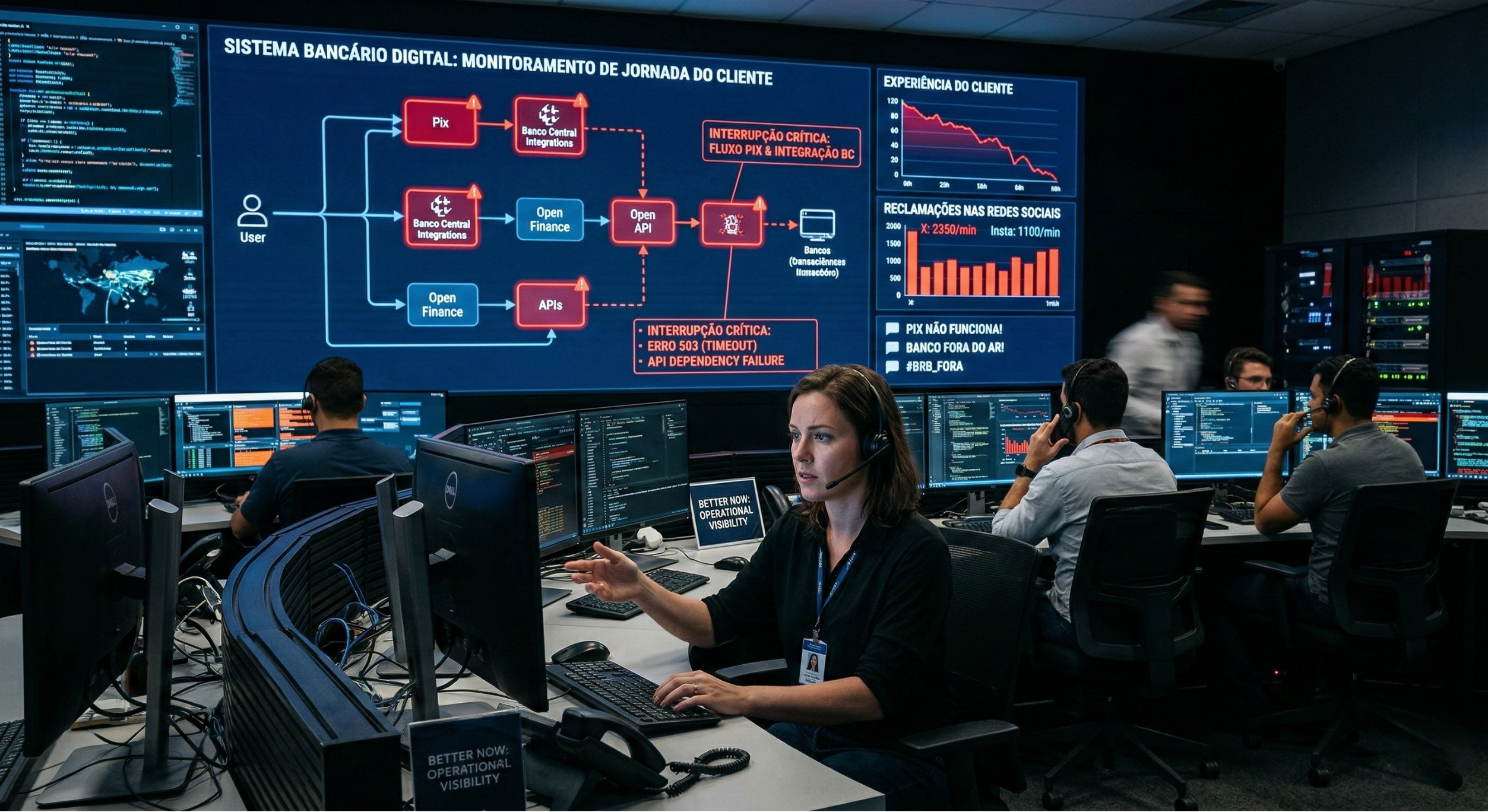
In recent weeks, we have seen new cases of unstable banking applications. And every time it happens, the same question comes up: Is your institution prepared to sustain a digital operation that never stops? Today, banking operates 24 hours a day. Pix, Open Finance, Central Bank integrations—everything happens in real time. There is no longer such a thing as “banking hours.” There is only constant expectation. When a bank goes offline, it is not just a technical issue. It is a sign that something within the operational ecosystem is not functioning as it should. And the impacts arrive quickly:
- Customers lose confidence
- Complaints appear on social media within minutes
- Regulatory teams go on alert
- Revenue is impacted
- Reputational damage can take months to repair
- Updates that were not fully validated end-to-end
- Critical integrations tested only partially
- APIs with dependencies that were never properly mapped
- Business rules that fail under specific conditions
- Stress tests that do not reflect actual transaction volumes
- Monitoring focused on servers but blind to the customer journey
- Lack of continuous testing across complete customer journeys
- Simulations that fail to reproduce real-world peak demand
- Manual regulatory validation processes
- Limited visibility into the actual user experience
- Operations
- Customer Service
- Communications
- Compliance
- Risk Management
- Executive Leadership
-
Automated and Continuous Testing
Critical workflows are constantly validated before customers encounter any issues. -
End-to-End Journey Monitoring
It is not enough to know whether a server responds. Institutions must verify that transactions start correctly, pass through every integration point, and complete successfully. -
Simulation of Challenging Scenarios
Peak volumes, partial failures, controlled outages, and business rule exceptions should all be tested. It is better to discover problems in a controlled environment than in production.
- End-to-end test automation
- Simulation of critical integrations (Pix, APIs, registries, and card networks)
- Continuous monitoring of transactional workflows
- Automated validation of business rules
Reconciliation is not just checking numbers — it is protecting revenue and reputation.
Discover how Better Now can transform financial reconciliation into its competitive edge.
*Your data is handled safely and in compliance with the LGPD.
For more information, see our Privacy Policy.
Other Articles
Contact Us
Doubts? Talk to us using the form below