
● Dataproof use case
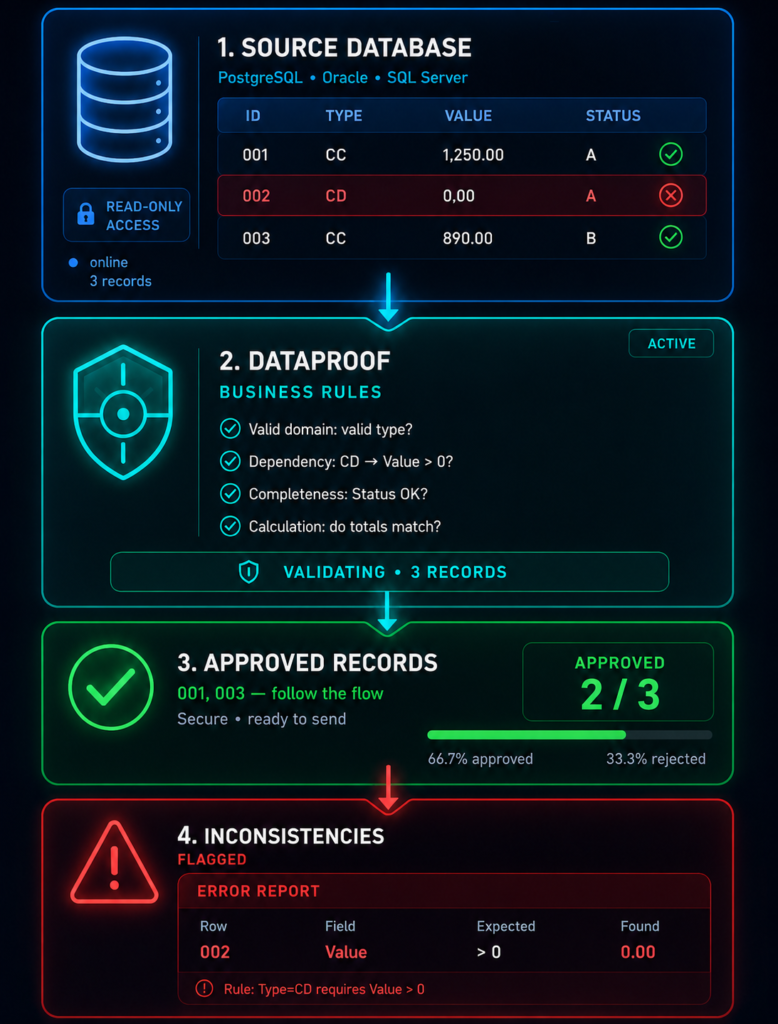
BACEN rejected its file. ETL said it was all right.
Dataproof applies the regulator’s business rules before shipping. So, when the file leaves its operation, it has already gone through the same sieve that the BACEN will use.
Why technical validation is not enough
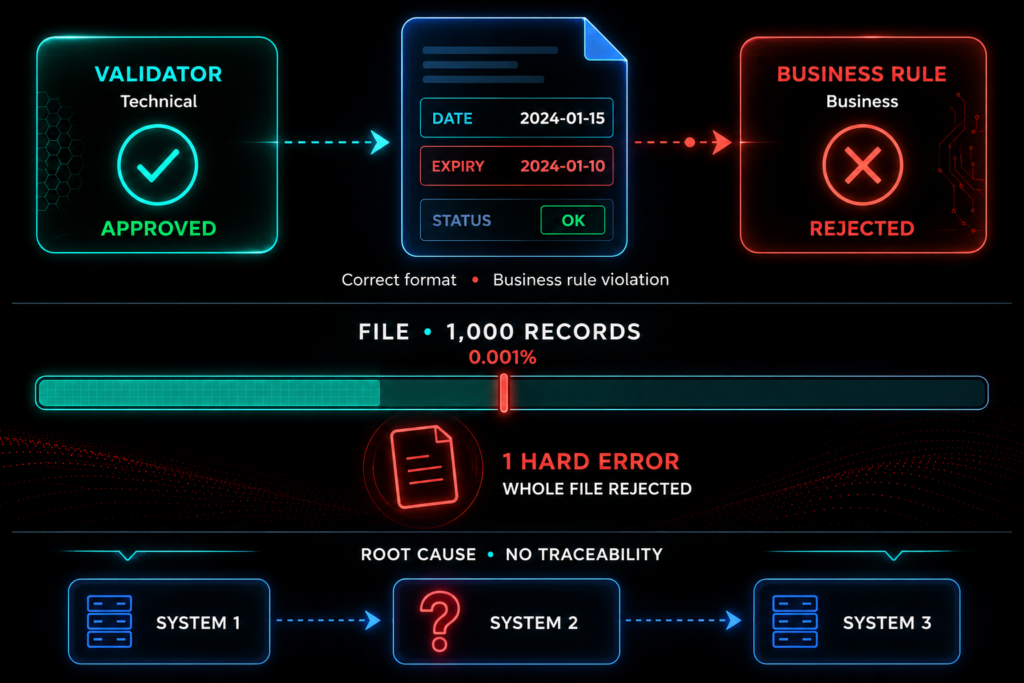
Three situations in which the file passes through the ETL and it arrives wrong with the regulator
The technical error vs. business
The date field was in the right format. The problem is that the salary was prior to the issuance, and BACEN has a business rule for that. ETL does not know this rule. The DataProof knows.
Total rejection for punctual error
When there is an inconsistency in any record, the regulator rejects the entire file. It doesn’t matter if the other 99.999% were perfect. The operation stops, the deadline expires and the fine arrives before the correction.
No trail to contest
When the regulator asks for an explanation about a specific field, the team needs to track which system generated that value. Without automatic trail, this means manual investigation days before you can give any answers.
Supported Layouts
The files that your regulator requires and that Dataproof already knows
Standard layouts with ready-made templates. Custom layouts via specification (without development).
Bacen (3040 and others)
Covers the Central Bank’s main reporting layouts, including COSIF, SCR, SPB, and PIX. Each is validated against the regulator’s specific business rules before submission, ensuring accuracy, compliance, and operational reliability.
3040
SCR
SPB
PIX
ISO 8583 – Flags
Visa, Mastercard, Hipercard, Elo, and other major card networks. Each transaction is validated against the respective network’s rules before transmission, ensuring field and value inconsistencies are identified and corrected before they result in chargebacks.
ISO 8583
VISA
Mastercard
SPED/Fiscal
SPED Fiscal, EFD-Contributions, and NF-e. Ensures the consistency of records and totals before submission to the Brazilian Federal Revenue Service’s Validation and Submission Program (PVA), reducing errors and strengthening tax compliance.
SPED Fiscal
EFD
NF-e
CNAB 240/CNAB 400
Remittance and bank return. Avoid rejection of boletos, duplicate payments and operational inconsistencies.
CNAB 240
CNAB 400
Regulatory XML and JSON
NF-e, CT-e, NFS-e, and regulatory APIs. Validates schemas, mandatory fields, and data consistency across elements, ensuring compliance, accuracy, and seamless integration between systems.
XML
JSON
XSD
Custom Layouts
Any layout with documented specification: positional, delimited, proprietary. Configuration via interface without code.
Positional
CSV
Own Layout
how it works
From the file generated to the sending with confidence in 3 steps
01
Configure layout and business rules
IT defines the layout once. Compliance Sets the rules of the regulator, without code to adjust when the manual changes.
02
Validate before shipping
Line by line, field by field. technical errors and business identified. million records in minutes.
03
Segregate errors, release the rest, document
Error records: Segregated with evidence. Healthy records: proceed to shipment immediately. Audit report: Automatic.
Demo
See the validation of a BACEN file in practice
use cases
where the validation of regulatory files generates immediate result
Shipping to BACEN (3040 / COSIF)
Outgoing flags (ISO 8583)
SPED Fiscal and EFD Contributions
CNAB (Remittance and Bank Return)
B2B Integration and Partner Certification
Why Dataproof for Regulatory Files
What changes in practice when you start to validate business rules along with the format
Business, not just format
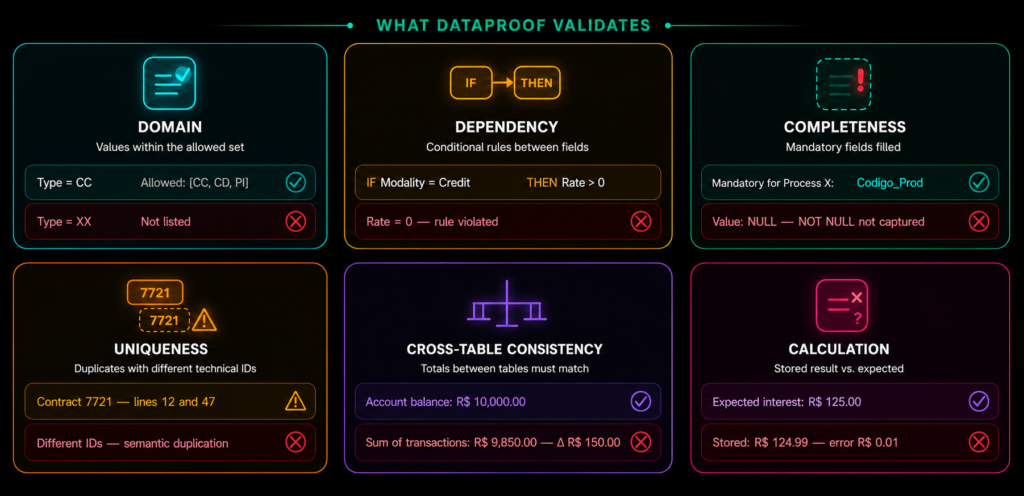
DataProof applies the same business rules used by regulators during their review process—rules that are not defined in any technical schema. This includes field dependencies, calculated thresholds, and logical sequencing validations that ETL processes alone cannot verify.
Segregation, not total rejection
When a record has inconsistency, it is segregated with evidence and the rest of the file goes on to send immediately. The operation does not stop because of a point error.
Evidence in minutes
Each validation generates automatic trail with line, field, applied rule and value found. When the regulator questions, the compliance team responds in minutes, with ready evidence, without having to ask for reconstitution of logs for the IT.
Rules maintained by Compliance
When the regulator’s manual changes, the compliance team updates the rules directly on the interface, without having to open a call to IT and without waiting for the next development sprint.
Batch performance
Files of millions of records processed in minutes. Predictable cost, no charge per call.
SaaS or On-Premises
Sensitive data? Rotate on your own datacenter or private cloud. Total sovereignty with the same evidence.
Frequently asked questions about validation of regulatory files
Does DataProof replace the official validation tools provided by the Central Bank of Brazil (BACEN) or the Brazilian Federal Revenue Service?
No, it runs before, as pre-validation. Detects both technical and business errors that the official validator would also identify. You don’t send the file to find it wrong; know before.
How do I update the rules when the regulator manual changes?
Compliance teams can access the DataProof interface and update validation rules without submitting requests to IT. This enables greater regulatory agility while maintaining distributed governance and control.
Can DataProof process files generated by different internal systems?
Yes. The validation is about the content of the file, regardless of the system that generated it. Integration via Watcher, API or manual upload.
How does segregation work in a positional file?
Error lines are separated into quarantine file with exact annotation of the problem. Healthy lines form a clean file for immediate shipment. The entire lot is never lost due to punctual errors.
What is the deadline to activate validation of a new layout?
Standard layouts such as 3040, SPED, CNAB, and ISO 8583 include reference templates and can typically be implemented within 1 to 3 days. Custom layouts can usually be delivered within 1 to 5 days after the specification is provided.
end-to-end armor
Combine with other capabilities
Databases Validation
Validate the data at the source (at the bank) before generating the regulatory file. The sooner, the cheaper to fix.
Multi-source reconciliation
After sending, reconcile what was sent to the regulator with what is in the internal systems.
next step
Want to know which rules of your regulator the current file is not complying?
Free Diagnosis: We identify the risks in your current process and demonstrate the shielding in a controlled environment.